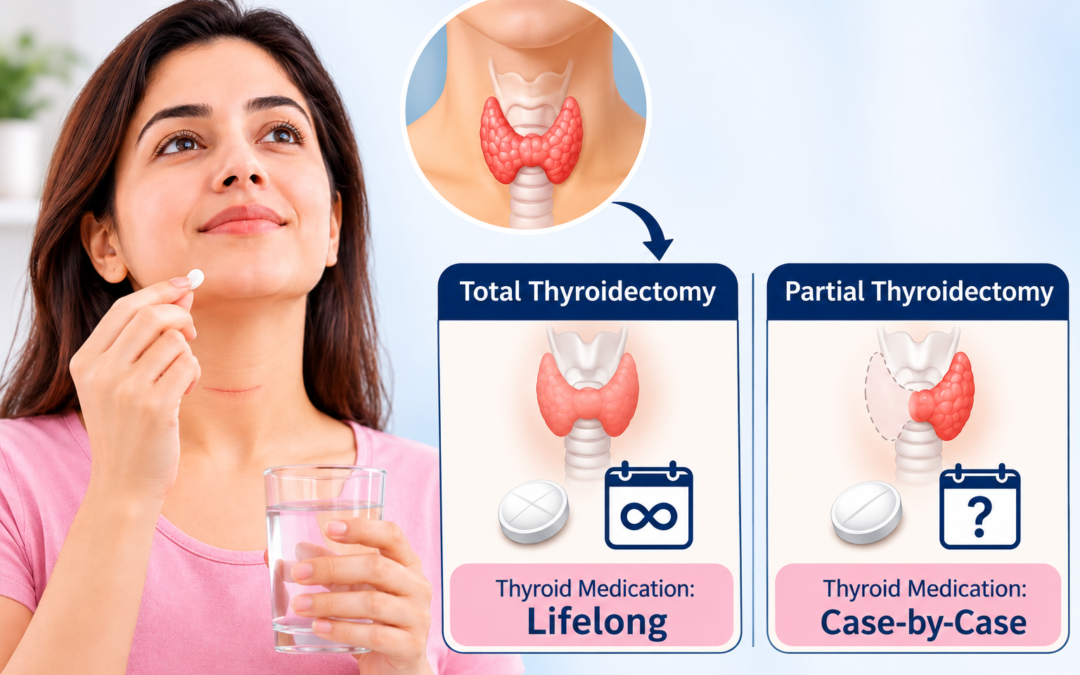
If the whole thyroid has been taken out, yes, the tablet is for life. Nothing else in your body makes that hormone. After removing only one side, it’s less clear. Some people never need a pill, some do, and the first blood test after surgery usually settles it. Most patients lead normal routines once the dose is right.
According to Prof. Dr. Sandeep Nayak, a specialist in thyroid cancer treatment in India, “Patients often worry about the tablet more than they need to. It’s one small pill in the morning. What matters is the follow-up test, because the dose that suits you in the first month may not suit you three years later.”
Not sure where you fit? Read the basics below, or send a general question through our contact page.
Who Needs Lifelong Thyroid Hormone Replacement After Thyroidectomy?

Total thyroidectomy: nothing is left to make hormones, so thyroid hormone replacement after thyroidectomy, usually levothyroxine, becomes a daily habit for good. It’s one part of the overall treatment plan.
-
After removing one lobe, some people need no medicine at all. Others do, if the remaining lobe can’t produce enough. Blood tests decide, not guesswork. (unchanged, since it wasn’t flagged)
-
With thyroid cancer, doctors sometimes aim for a slightly lower TSH than normal, so the dose can run a bit above plain replacement. How much depends on your risk category, and your own doctor sets it. If you need radioactive iodine therapy, that comes into the picture too.
-
If you already had Hashimoto’s or an underactive thyroid, tablets are more likely even after a partial removal.
What Daily Life After Thyroid Removal Looks Like

- Pick a time and stick to it. Most people take the tablet first thing, with plain water, about 30 to 60 minutes before breakfast. The first few weeks can feel uncertain, so it helps to know how long levothyroxine takes to work.
- Keep calcium and iron away from it. They can stop the tablet from being absorbed properly. Antacids do the same. A gap of around four hours is the usual advice.
- Give the dose time to settle. In the early weeks you might feel tired, a bit low or colder than usual. That doesn’t always mean something is wrong. Most doctors repeat the TSH test 6 to 8 weeks after starting or changing a dose.
- Carry on with your normal routine. Work, exercise and regular meals are all fine. You don’t need a special diet. The low-iodine diet is only for people preparing for radioactive iodine. For the longer view, see life after thyroid cancer.
What Decides Your Thyroid Hormone Dose?
- How much of the thyroid was removed
- Your body weight and age
- Your TSH result, and sometimes free T4
- Whether the surgery was for cancer, and the risk level
- Other conditions or situations, such as pregnancy, heart disease or digestion problems
- Other medicines or supplements you take, and how you take the tablet
Key Takeaways
- Total thyroidectomy means lifelong thyroid hormone tablets.
- After partial removal, the need is decided by blood tests.
- Take the tablet at the same time daily, on an empty stomach.
- Doses are adjusted using TSH tests, usually 6 to 8 weeks after any change.
- Most people return to normal routines while on stable treatment.
Frequently Asked Questions
Do I still need tablets if only half my thyroid was removed?
Maybe. Some people stay well on the remaining half, while others need tablets. Your TSH levels after surgery will show which group you’re in.
I feel completely fine now. Can I stop the tablets?
No. Feeling fine is usually the tablet doing its job. After a total thyroidectomy, stopping brings hypothyroidism back, often within weeks.
Is it okay to switch brands?
Brands can differ slightly in how they’re absorbed. Don’t switch on your own. If your doctor does change it, get a TSH test a couple of months later so the dose can be checked.
I forgot my tablet today. What should I do?
Take it as soon as you remember, even if it’s later in the day. If you missed it completely, just carry on the next morning. Don’t double up unless your doctor has told you to.
References
- Jonklaas J, et al. Guidelines for the Treatment of Hypothyroidism (ATA). Thyroid, 2014. https://doi.org/10.1089/thy.2014.0028
- Haugen BR, et al. 2015 ATA Management Guidelines for Adult Patients with Thyroid Nodules and Differentiated Thyroid Cancer. Thyroid, 2016. https://doi.org/10.1089/thy.2015.0020
- Cancer Institute NSW. Thyroid hormone replacement therapy. https://www.cancer.nsw.gov.au/thyroid-cancer/diagnosis-and-treatment/treatment/types-of-treatment/thyroid-hormone-replacement-therapy
- American Thyroid Association. Hypothyroidism. https://www.thyroid.org/hypothyroidism/
Disclaimer: This content is for informational purposes only and does not replace a consultation with a qualified physician.