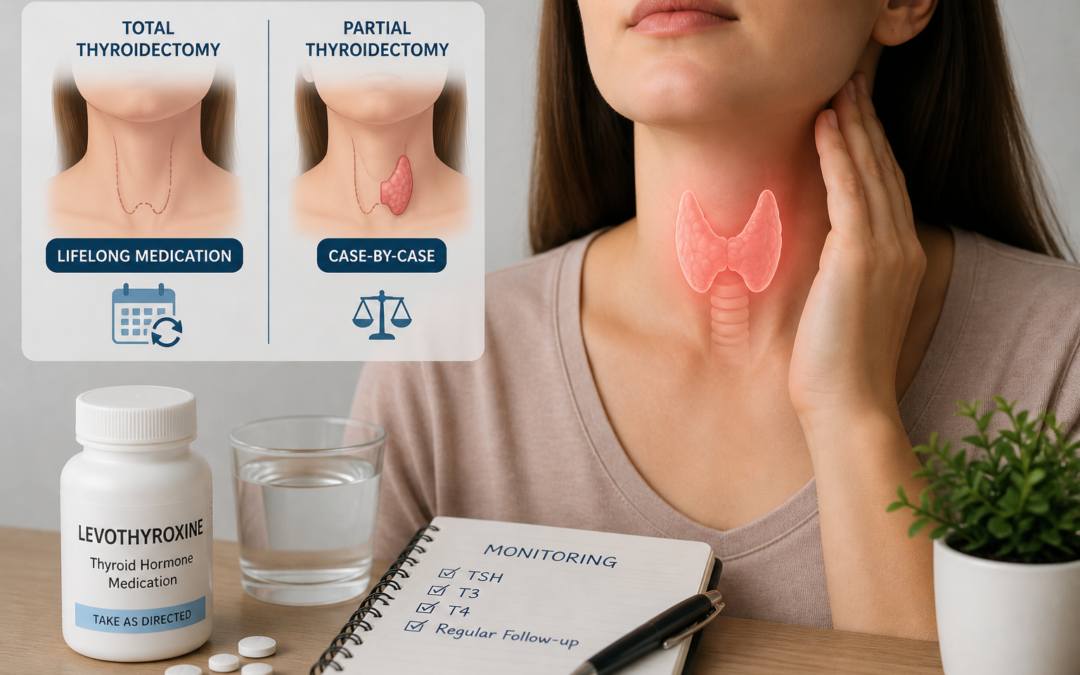
A total thyroidectomy takes out the whole gland, while a partial one removes just one side. Which one fits depends on what’s wrong, how big it is, and whether cancer is involved. Smaller, low-risk problems can often be handled with half the gland. Larger or riskier ones usually need all of it.
According to Prof. Dr. Sandeep Nayak, a specialist in thyroid cancer treatment in India, “Patients often ask which operation is safer. Neither one is safer in every case. The right one treats the problem fully without taking more than needed, and that call is made after the scans, the biopsy and a proper conversation.”
Confused about total vs partial thyroidectomy? Get expert guidance to choose the right approach for you
Total Thyroidectomy vs Partial Thyroidectomy at a Glance
Here’s the difference between total and partial thyroidectomy, side by side:
|
Point |
Total thyroidectomy |
Partial thyroidectomy (lobectomy) |
|
What’s removed |
The entire gland |
One lobe, usually with the isthmus. The other lobe stays |
|
Usually considered for |
Larger or higher-risk cancers, spread to lymph nodes, disease in both lobes, medullary cancer, goitre on both sides |
Small, low-risk cancers in one lobe, or a benign or uncertain nodule on one side |
|
Thyroid tablets afterwards |
Daily, for life |
Not always. Blood tests decide |
|
Radioactive iodine |
Can be given if needed |
Usually not used |
|
Thyroglobulin follow-up |
A useful tracking marker |
Less reliable, since remaining thyroid also makes it |
|
Low calcium risk |
Higher chance, often temporary |
Lower |
|
Voice nerve |
Nerves on both sides are at risk |
Nerve on one side is at risk |
|
Chance of a second surgery |
Low |
Possible, if the final report shows higher-risk features |
If cancer is the concern, the type matters a lot. See the page on papillary thyroid cancer for the most common kind. Radioactive iodine therapy explains why the whole gland is often removed first when that treatment is planned.
When Each Option Is Usually Chosen

- Partial removal is often considered for a small, low-risk cancer sitting in one lobe, or a benign or indeterminate nodule on one side. Sometimes it’s done to get a definite diagnosis.
- Total removal is usually considered when the cancer is larger, has reached lymph nodes or tissue outside the gland, or involves both lobes. Medullary cancer and goitres on both sides also fall here.
- Think about aftercare too. Total removal means a daily tablet for good. Our guide to life on thyroid medication after thyroidectomy covers what that looks like.
- The way it’s done is a separate question. In suitable patients, either operation can be done through a hidden incision, as explained under scarless robotic thyroid surgery.
What Factors Decide Between a Total and Partial Thyroidectomy?
- Size of the nodule or tumour
- Biopsy (FNAC) result and what it suggests
- Ultrasound features, and whether lymph nodes look involved
- Whether one lobe or both are affected
- Family history, past radiation exposure or genetic risk
- Whether radioactive iodine is likely to be needed
- Age, general health and calcium or voice concerns
- Your own preferences, after the options are explained
Key Takeaways
- Total removes the whole gland. Partial removes one lobe.
- Smaller, low-risk conditions often suit partial removal. Larger or higher-risk ones usually need total.
- Tablets are lifelong after total removal and not always needed after partial.
- A partial surgery can still lead to a second operation if the final report changes the picture.
- The decision is individual and is made after scans, biopsy and discussion with your surgeon.
Frequently Asked Questions
Can I pick partial removal so I won’t need tablets?
Sometimes, but only when it’s medically suitable. If the condition needs the whole gland out, avoiding tablets isn’t a good reason to choose less. Some people need tablets even after partial removal.
Could I need another operation after a partial thyroidectomy?
It can happen. The lab report comes back a week or so after surgery, and now and then it shows something the scans missed. If so, the other lobe may have to come out as well. That second operation is called a completion thyroidectomy.
Is a total thyroidectomy riskier?
A little, yes. With the whole gland out, the parathyroids on both sides are in the surgical field, so low calcium is more common, though it’s often temporary. The voice nerves on both sides are involved too. A surgeon who does this regularly keeps those risks low, and it’s fair to ask yours about their own results.
Do I need radioactive iodine if only one lobe is removed?
Usually not. Radioactive iodine works best when little or no thyroid tissue is left, so it’s mostly used after total removal when the cancer’s risk features call for it.
References
- Haugen BR, et al. 2015 American Thyroid Association Management Guidelines for Adult Patients with Thyroid Nodules and Differentiated Thyroid Cancer. Thyroid, 2016. https://doi.org/10.1089/thy.2015.0020
- American Thyroid Association. Thyroid Surgery. https://www.thyroid.org/thyroid-surgery/
- American Thyroid Association. Thyroid Cancer (Papillary and Follicular). https://www.thyroid.org/thyroid-cancer/