It was still dark when Renukamma stepped down into the courtyard. She had made that step ten thousand times. This time she misjudged it, went over sideways, and caught her right shin on the edge of the stone water channel, opening a gash from below the knee.
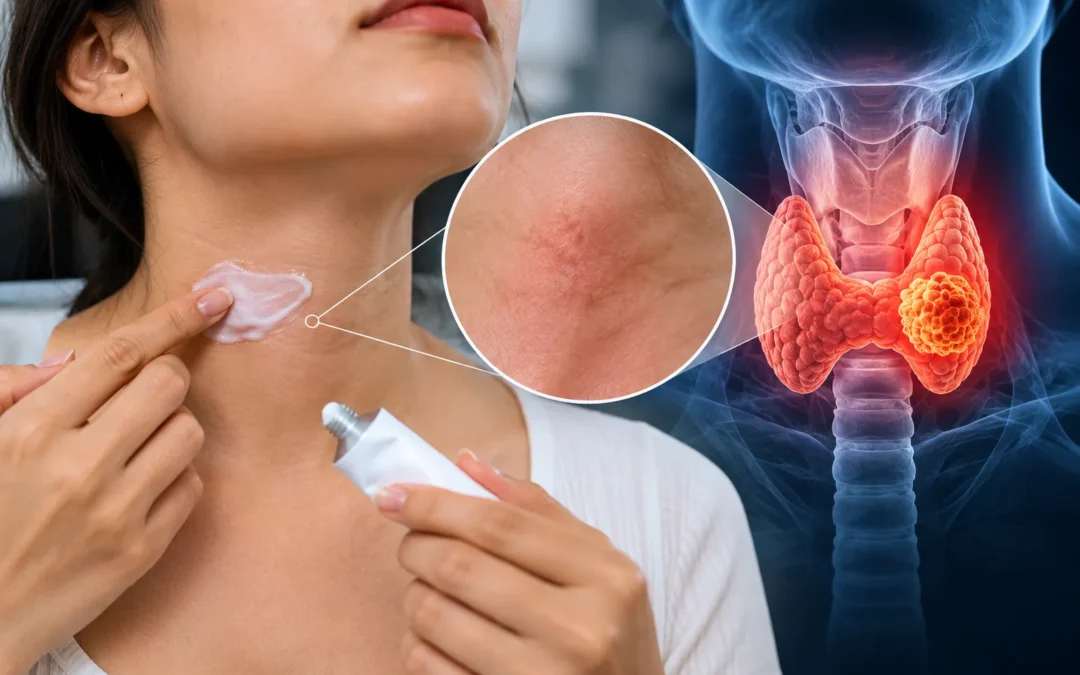
Her son walked to the pharmacy in the next village and came back with what any pharmacy in India will hand over for an open wound: a tube of povidone-iodine ointment. She dressed the leg with it morning and night for ten days. The wound healed cleanly.It was the most ordinary thing that happened to her that month. It nearly wasted a course of cancer treatment.
Renukamma is 46, grows sugarcane with her husband and two sons outside Bagalkot, and had felt perfectly well until a lump in her neck was noticed at a family wedding. The ultrasound and needle test found a papillary thyroid carcinoma. Surgery found more: a 3 cm tumour with two smaller separate foci, and four involved lymph nodes in the central compartment. Her thyroid came out entirely. Six weeks later she was referred to us for radioactive iodine.
Preparing for radioactive iodine therapy?
What the capsule is supposed to do
Radioactive iodine has been treating thyroid cancer since the 1940s, which makes it the oldest targeted cancer therapy still in daily use. It works on a single biological quirk. Thyroid cells need iodine to make thyroid hormone, and they pull it out of the bloodstream with a pump that almost no other tissue in the body has. Thyroid cancer cells, disorganised as they are, usually keep that pump.
So a patient swallows a capsule of iodine-131. Any thyroid tissue left anywhere in the body drinks it, and the iodine emits beta particles that travel one or two millimetres before stopping, delivering their dose from inside the cell that took them up. Nobody has to know where those cells are. After surgery this does three jobs: it destroys the remnant the surgeon inevitably leaves behind, so that blood thyroglobulin becomes a clean marker of recurrence; it treats microscopic disease in the neck; and it treats deposits in nodes, lungs or bone.
There is one catch. The pump cannot tell radioactive iodine from ordinary iodine. Flood the bloodstream with the stable kind and the radioactive dose is diluted, most of it is simply passed in urine, and very little reaches the tumour.The pump cannot tell one iodine from the other.That is why the preparation matters. Patients come off thyroxine for four weeks so that TSH rises and drives the pump hard, and they spend two weeks on a low-iodine diet so the pump has nothing else to swallow.

Renukamma did the diet strictly. She refused curd at a wedding. What nobody had told her was that iodine can also arrive through a hole in the skin.The withdrawal, meanwhile, was doing what it always does. By the third week she was deeply hypothyroid: slow, cold, puffy, unsteady. That is the point of it, and it is also how she came to misjudge a step she had known all her life.
She arrived for her diagnostic scan with a TSH of 71 mIU/L, so the withdrawal had worked. Her stimulated thyroglobulin came back at 16 ng/mL, which in a woman with no thyroid gland means there is thyroid tissue somewhere, almost certainly tumour.
The whole-body scan showed nothing. A faint blush in the thyroid bed, no nodal uptake, no distant disease. A raised thyroglobulin with a blank scan has a short differential. Either the tumour has dedifferentiated and stopped concentrating iodine, which would be unusual in a woman of her age with classical papillary histology, or the patient is iodine-loaded. We went through the checklist. No CT contrast. No amiodarone. No cough syrups, no supplements. Then someone asked about the wound on her leg.
Ten days of povidone-iodine ointment on an open wound. Broken skin absorbs it readily, and by the time she swallowed her tracer she had been circulating ordinary iodine for weeks. Her tumour had taken up all it needed. The radioactive dose arrived to find every seat taken, and left in her urine.
We did not give the therapy dose that week. Had we gone ahead, the 100 millicuries would have been largely wasted. She would have taken on the radiation exposure, the isolation and the salivary gland risk for poor ablation of disease we knew was there, and she would have carried a falsely reassuring post-therapy scan into her follow-up.
Instead we restarted her thyroxine so she would not spend another six weeks hypothyroid, waited five weeks for the iodine load to clear, then prepared her again with recombinant TSH injections rather than a second withdrawal, and put her back on the low-iodine diet.
The second scan lit up the thyroid bed and a discrete node at level III on the left that the first scan had missed entirely. She received 100 mCi. The post-therapy scan confirmed both sites. At twelve months her stimulated thyroglobulin was undetectable and her neck ultrasound was clean.
Have questions about radioiodine preparation?
The Point
The counselling before radioiodine is usually a diet sheet. No iodised salt, no seafood, no dairy. Patients follow it, because it is written down.Our checklist had been built for the things that show up in a hospital file. We asked about contrast studies, which need six to eight weeks to clear. We asked about amiodarone, which needs months. We never once asked whether anyone had put anything on their skin. A cut is not a medical event to a patient, and a tube from a village pharmacy is not a drug. Neither of them enters the history unless somebody asks.
What Renukamma changed for us is the way the preparation is explained. The low-iodine instruction is not a diet. It is a rule about iodine in every form it arrives in, for the whole six weeks: not only salt and seafood and dairy, but gargles, douches, ointments, wound dressings, antiseptic washes, anything on a pharmacy shelf with iodine in its name. Patients keep to instructions when they understand what the instruction is protecting. Told only to avoid seafood, a woman with a torn shin will reach for betadine and think nothing of it, because nothing in what she was told connects the two.
Renukamma did nothing wrong. Nobody had told her that an ointment could interfere with a capsule she had not yet swallowed. Now we also ask about cuts.
Frequently Asked Questions
Can povidone-iodine ointment affect radioactive iodine therapy?
Yes. Povidone-iodine contains iodine, and significant iodine exposure can interfere with radioactive iodine uptake. This is particularly relevant when iodine-containing products are used repeatedly or on broken skin. Tell your treating team about any recent use.
Can iodine applied to the skin enter the bloodstream?
Yes. Iodine from topical preparations can be absorbed through the skin, with absorption potentially greater when products are applied to damaged or open skin. The clinical significance depends on the amount and duration of exposure.
Why is iodine restricted before radioactive iodine treatment?
Radioactive iodine therapy relies on thyroid cells taking up iodine. A high iodine load can reduce uptake of iodine-131, potentially lowering the amount of radioactive iodine delivered to thyroid tissue or thyroid cancer cells.
Should I avoid all iodine-containing products before radioactive iodine therapy?
Not necessarily without medical guidance. Patients should follow the specific preparation instructions provided by their nuclear medicine or thyroid cancer team and disclose iodine-containing medicines, antiseptics, supplements, contrast exposure, and topical products.
What products can contain iodine besides food?
Iodine exposure can come from several sources, including iodinated contrast used in some imaging procedures, amiodarone, iodine-containing supplements, povidone-iodine antiseptics, some wound preparations, and other iodine-containing medical products.