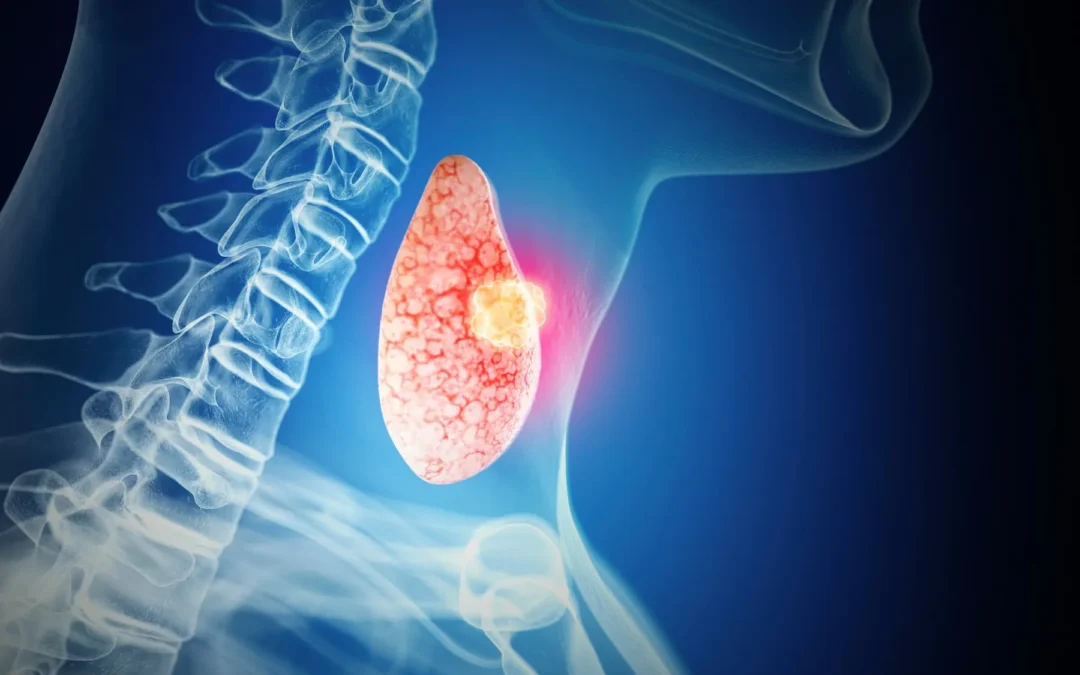
Thyroid nodules are benign, but roughly 5–10% are malignant. Nodules are considered higher risk when they’re solid rather than fluid-filled, irregular in shape, taller than wide on ultrasound, or found in a patient with a family history of thyroid cancer. Hard texture on palpation raises suspicion too. Size alone doesn’t determine cancer risk; a 5 mm nodule with suspicious ultrasound features can be more dangerous than a 3 cm cyst.
According to Prof. Dr. Sandeep Nayak, a specialist in thyroid cancer treatment in India, “A nodule’s echogenicity, microcalcifications, and irregular margins on ultrasound are stronger predictors of malignancy than its size alone.”
Been told you need thyroid surgery and want the plan reviewed first?
What Ultrasound Features Make a Nodule Suspicious for Cancer?
Ultrasound is the first investigation that flags whether a nodule needs further workup; specific characteristics carry more diagnostic weight than others.
- Microcalcifications: Tiny calcium deposits inside a nodule are one of the strongest ultrasound markers of papillary thyroid cancer, appearing as small bright spots that don’t cast a shadow behind them.
- Solid composition: Purely solid nodules carry a meaningfully higher malignancy risk than cystic or mixed ones, because cancerous tissue doesn’t liquefy the way benign cysts do.
- Taller-than-wide shape: A nodule that grows across tissue planes rather than along them suggests aggressive infiltration this shape, measured on transverse imaging, is an independent risk factor.
- Irregular margins: Borders that look lobulated or spiculated on ultrasound are associated with cancer more often than smooth, well-defined edges, though benign nodules can sometimes appear irregular too.
Ultrasound findings alone don’t confirm cancer a fine needle aspiration biopsy is needed for cytological diagnosis. Explore thyroid cancer surgery when FNAC suggests malignancy.
Which Patient Factors Increase the Chance a Nodule Is Cancerous?
Ultrasound findings matter, but patient history adds context that changes how urgently a nodule needs evaluation.
- Family history: A first-degree relative with papillary or medullary thyroid cancer increases individual risk substantially, and these patients need earlier and more aggressive workup even for smaller nodules.
- Radiation exposure: Prior head or neck radiation whether from childhood cancer treatment or environmental exposure is one of the best-established risk factors for thyroid malignancy, particularly in younger patients.
- Rapid growth: A nodule that visibly enlarges over a few weeks to months, especially with hoarseness or difficulty swallowing, warrants immediate evaluation since slow-growing benign nodules rarely change that fast.
- Male sex, younger age: Thyroid nodules are far more common in women, but when they appear in men or in patients under 20 or over 70, the probability of malignancy is statistically higher than in middle-aged women.
Risk factors don’t diagnose cancer they guide how aggressively a nodule is investigated. Read more about thyroid nodule evaluation and when to act.
Why Choose Dr. Sandeep Nayak for a Thyroid Surgery Second Opinion?
Dr. Sandeep Nayak is one of India’s most experienced thyroid surgeons, specialising in minimally invasive and robotic thyroid cancer surgery at MACS Clinic. He developed the RABIT technique, a robotic-assisted bilateral axillo-breast approach for scarless thyroidectomy, and has performed thyroid operations on patients from across India and abroad.
His outcomes speak plainly. Patients who arrive with complex or recurrent thyroid cancers, cases other centres have declined, leave with completed resections and functioning nerves. That’s what three decades of high-volume thyroid surgery produces.
Frequently Asked Questions
Which nodule size needs biopsy?
Nodules 1 cm or larger with suspicious ultrasound features typically need fine needle aspiration biopsy.
Can a cancerous thyroid nodule go away on its own?
No, malignant thyroid nodules don’t resolve without surgical or medical treatment.
Is a hard thyroid nodule always cancer?
Not always, but firm or hard consistency on palpation does increase suspicion for malignancy.
Does a thyroid nodule always cause symptoms?
Most don’t the majority of thyroid nodules are found incidentally on imaging for unrelated conditions.
References:
- National Cancer Institute Thyroid Cancer Treatment (PDQ)
- Ultrasound Features of Malignant Thyroid Nodules PMC/NCBI
Disclaimer: This content is for informational purposes only and does not replace a consultation with a qualified physician.