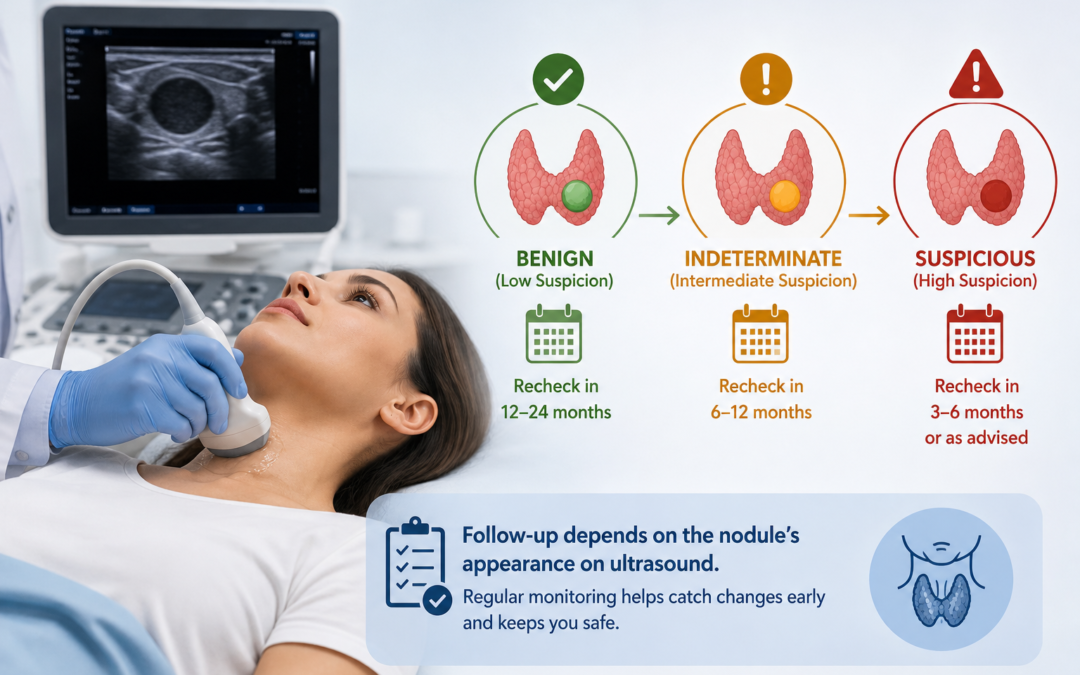
If you’ve been told to just watch a nodule, the gap between scans isn’t the same for everyone. A nodule with worrying features may be looked at again in 6 to 12 months. One that looks very safe might go years between scans. Your first ultrasound, and any biopsy result, set the schedule.
According to Prof. Dr. Sandeep Nayak, a specialist in thyroid cancer treatment in India, “Most people with a nodule only need to be watched, and that’s perfectly fine. The follow-up scan isn’t a sign that we’re worried. It’s how we make sure a quiet nodule stays quiet.”
Have a nodule and wonder what your own schedule should look like? Read the overview below, or send a general question through our contact page.
Thyroid Nodule Follow-Up: Why the Gap Between Scans Differs
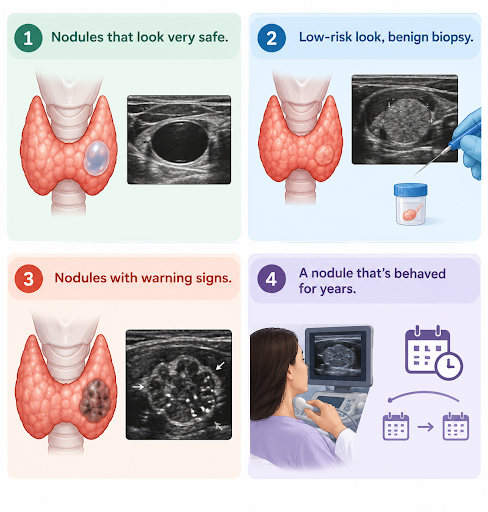
- Nodules that look very safe. Mostly fluid or sponge-like ones may need one early recheck, or barely any follow-up. Most nodules land here, as covered in are all thyroid nodules dangerous.
- Low-risk look, benign biopsy. Many doctors scan again after a year or two. If nothing has moved, the wait usually gets longer.
- Nodules with warning signs. Solid, dark, uneven edges, tiny calcium specks: these get a closer watch, often within 6 to 12 months, and sometimes a second biopsy. Here’s which thyroid nodule is more likely to be cancer.
- A nodule that’s behaved for years. After several matching scans, plenty of doctors spread the checks out to every few years, or stop altogether.
What Thyroid Nodule Monitoring Involves Between Scans

- The ultrasound itself. The radiologist measures the nodule in three directions and compares its look with the last scan. Using the same centre helps, because measurements can vary a little between machines and people.
- Your own eyes and throat. Don’t wait for the date if the lump grows, your voice turns hoarse, swallowing gets harder or the neck feels tight. Those are reasons to book a visit early.
- A blood test. TSH is often checked, mainly to see whether the nodule is making extra thyroid hormone.
- A treatment talk, if needed. If a nodule keeps growing or causes pressure, options can be discussed, including radiofrequency ablation for thyroid nodules or the approaches covered in discovering solutions for thyroid nodules.
What Can Change Your Recheck Schedule?
- The ultrasound features of the nodule
- The biopsy (FNAC) result, if one was done
- Size now, and how fast it has grown
- Symptoms such as pressure, voice change or trouble swallowing
- A family history of thyroid cancer, or past radiation to the neck
- Whether there are several nodules or only one
- Your age and general health, and your own preference after the options are explained
Key Takeaways
- A repeat neck ultrasound is the usual way to keep an eye on a nodule that stays in.
- Suspicious-looking nodules may be rechecked in 6 to 12 months. Very safe-looking ones can go years between scans.
- Even with a benign biopsy, most people get at least one more scan.
- Nodule grew quickly, or your voice changed? Call the clinic before your date comes round.
- Your own report sets the schedule, so two people with nodules can get very different advice.
Frequently Asked Questions
My biopsy came back benign. Why would I need another scan?
A biopsy only takes a few cells from one spot in the nodule. It’s good news, but it isn’t a guarantee, and nodules can change later. A scan after a year or two is a simple way to be sure.
My nodule measured 1 mm bigger this time. Should I worry?
Probably not. Two scans can differ by a millimetre or two just because of who holds the probe. What your doctor looks for is steady growth across several visits, or a change in how the nodule looks.
Do nodules ever shrink or vanish?
Fluid-filled ones sometimes do. Solid ones almost never disappear, though plenty sit unchanged for years without causing any trouble.
I have no symptoms at all. Is follow-up really necessary?
It’s better not to skip it. Most nodule changes cause no symptoms at all, and the scan is how they’re picked up.
References
- Haugen BR, et al. 2015 American Thyroid Association Management Guidelines for Adult Patients with Thyroid Nodules and Differentiated Thyroid Cancer. Thyroid, 2016. https://doi.org/10.1089/thy.2015.0020
- Tessler FN, et al. ACR Thyroid Imaging, Reporting and Data System (TI-RADS): White Paper of the ACR TI-RADS Committee. J Am Coll Radiol, 2017. https://doi.org/10.1016/j.jacr.2017.01.046
Disclaimer
This article is for educational and informational purposes only and does not constitute medical advice, diagnosis or treatment. It is not a substitute for consultation with a qualified healthcare professional. Please talk to your doctor about your own nodule, scan results and follow-up plan.